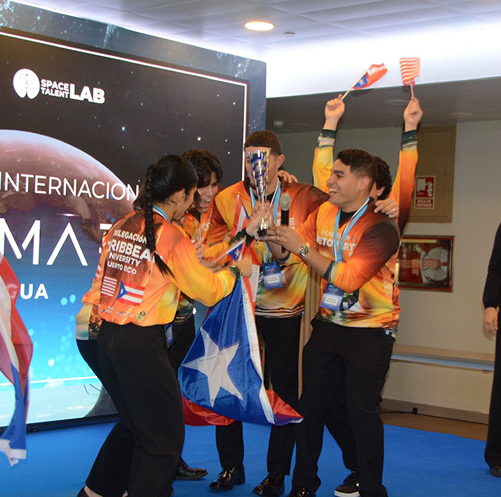



Challenge your limits! Join the Mars Challenge and help us build a better future for humanity!

Target
The main objective of the Mars Challenge program is to foster the development of interdisciplinary solutions to address the challenges of inhabiting Mars, but it also has secondary objectives such as promoting collaboration and knowledge exchange among students from universities in Ibero-America and providing significant benefits for participants in terms of skills development and enhancement of their professional profile.
In addition:
Encourage the generation of human capital, at the university level, for the aerospace industry, to accompany the acceleration that the sector has experienced in the last 15 years.
To promote STEAM education in Latin America and the Caribbean.

Specific challenge
For the Mars Challenge 2023 hackathon, the specific challenge is to develop innovative solutions that will enable a six-member aerospace crew to survive for a two-year period on Mars.
This challenge is a great opportunity for university students to develop valuable skills in the aerospace field, while fostering values such as collaboration and critical thinking.
DESCRIPTION OF
THE INTERVENTION
Phases during 2023, to develop STEAM-based interdisciplinary solutions for inhabiting Mars.
Phase I: Country Hackathon (May-September 2023) – Each country hosts an aerospace hackathon; winners form a team that competes in the Final Hackathon.
Phase II: Highest Impact Country Project (October 2023) – Phase I winning teams present their project to a jury; the team with the highest impact is recognized as the Ibero-American winner.
Phase III: Final Hackathon (October 2023) – Phase I winners compete in international teams to develop a disruptive solution to a new challenge.
Judging criteria for the Challenge Mars 2023 hackathon
The evaluation of the projects presented in the Mars Challenge 2023 Hackathon will be based on nine equally weighted criteria.
These criteria include impact, creativity, design, completion, learning, validity, relevance, technical and presentation.
You can review the details of each of them in the following document
Be sure to read them carefully so that you can excel in each of the criteria!

Virtual Educa is an initiative that originated in 2001, whose purpose is to promote innovation in education to foster social transformation, sustainable development and citizen awareness, especially in Latin America and the Caribbean.
To this end, it operates through an alliance of international organizations, multilateral agencies and public and private institutions, bringing together the public, business, academic and civil society sectors.
NASA Johnson Space Center
The NASA logo and images on this website are property of NASA (National Aeronautics and Space Administration).